
All 10 provinces and 3 territories
IPTV in Canada by Province and Territory
IPTV in Canada works the same way in every province: the same channels, the same prices in Canadian dollars and the same support. What changes is your time zone, your local channels, the language you watch in and the internet you can get. This guide covers each region, with links to our city guides.
- 10 city guides
- English and French support
- Same price in every province
Does IPTV work everywhere in Canada?
Yes. IPTV works anywhere in Canada with a stable internet connection, from a condo in downtown Toronto to a farm outside Saskatoon. You need about 10 Mbps per screen for Full HD and about 25 Mbps for 4K, and most homes on cable or fibre have plenty.
IPTV struggles on slow DSL, on fixed wireless with a weak signal, and on satellite plans with data caps. Those are more common in rural areas and in the North, so if that sounds like your home, test the service before you pay.
Canadian IPTV from IPTV Nord has one price across the country, billed in CAD. Support answers in English and French, 7 days a week, 9 a.m. to midnight (Eastern Time). Those hours are set in Eastern Time, so they start and end earlier the further west you live.
City guides
IPTV city guides across Canada
Each city guide covers local channels, the teams people follow, time zone tips and the internet options in that area. Pick yours, or read your province below.
- IPTV TorontoOntario · Eastern time
- IPTV MontrealQuebec · Eastern time
- IPTV VancouverBritish Columbia · Pacific time
- IPTV CalgaryAlberta · Mountain time
- IPTV EdmontonAlberta · Mountain time
- IPTV OttawaOntario · Eastern time
- IPTV Quebec CityQuebec · Eastern time
- IPTV WinnipegManitoba · Central time
- IPTV HamiltonOntario · Eastern time
- IPTV HalifaxNova Scotia · Atlantic time
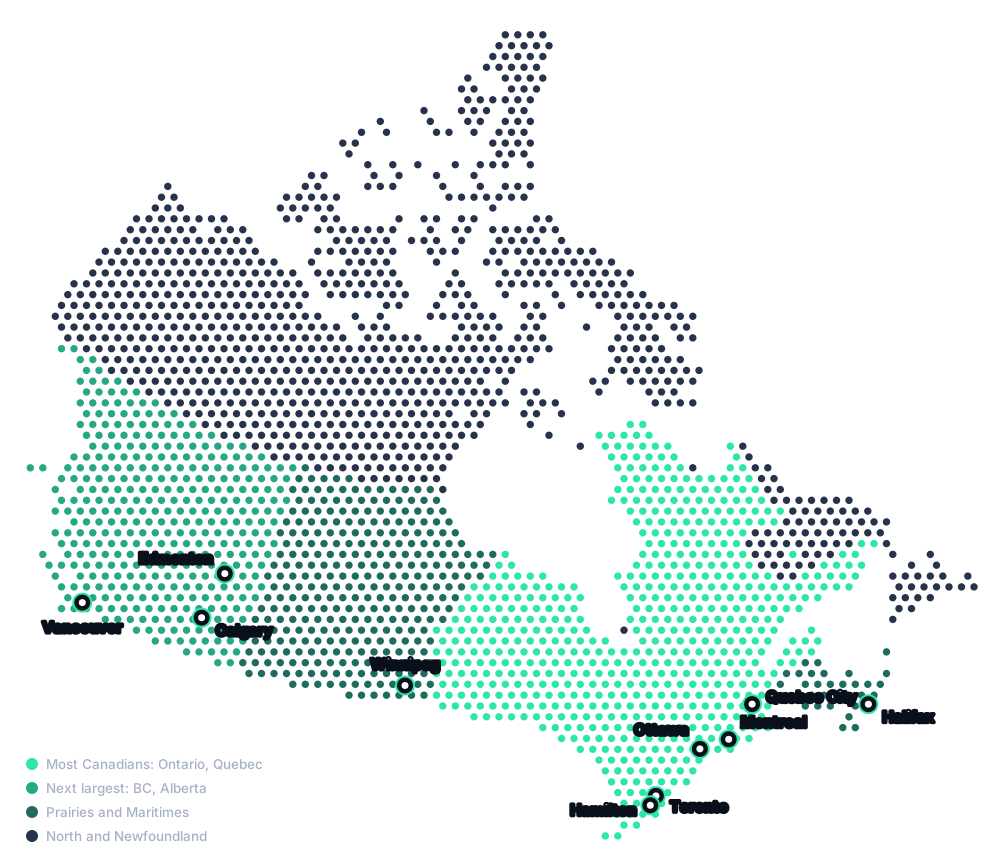
IPTV Ontario: Toronto, Ottawa, Hamilton and the rest of the province
IPTV works across Ontario, the province where more Canadians live than anywhere else. In the GTA, Ottawa and Hamilton, most homes can choose cable or fibre internet, which is ideal for streaming on several screens at once. Read the local notes for IPTV in Toronto and the GTA, IPTV in Ottawa and IPTV in Hamilton.
Every plan includes local channel groups for Toronto and the GTA and for Ottawa and Gatineau, plus Canadian sports in English and French. Maple Leafs and Senators games are split between national and regional broadcasters, so check the TV guide before puck drop.
Franco-Ontarian homes in Ottawa, Sudbury and eastern Ontario can keep French channels with the Full Channels package. In parts of northern and rural Ontario, internet still runs on DSL or fixed wireless, so the free trial is worth doing first.
IPTV Quebec: French and English TV in Montreal and Quebec City
IPTV in Quebec works best with the Full Channels package, which puts French-language news, variety and sports next to English channels in one guide. Our support team answers in French, from the first question to the setup on your TV.
In Montreal, one login often has to please a bilingual household: French news for one person, an English game for another. Quebec City homes tend to watch mostly in French. See our guides to IPTV in Montreal and IPTV in Quebec City for local details.
Canadiens games draw big audiences in both languages, and the TV guide shows which broadcast is on which channel. Vidéotron, Bell and Cogeco offer cable and fibre internet in most Quebec cities.
IPTV BC: British Columbia on year-round Pacific Time
IPTV works well in Vancouver, Victoria, Kelowna and most BC towns with cable or fibre internet from providers like TELUS and Rogers, which now includes the former Shaw network. In the Interior and mountain areas, some homes rely on fixed wireless or satellite, so test there first.
The big change in BC is time. Since 2026, most of the province stays on Pacific Time (UTC-7) all year and no longer turns clocks back in November. A 7 p.m. Eastern game now starts at 5 p.m. in Vancouver in winter and 4 p.m. in summer. Catch-up helps here: start a Canucks road game from the beginning when you get home.
Local channels for Vancouver and BC are part of every plan. Read our guide to IPTV in Vancouver for more.
IPTV Alberta: Calgary, Edmonton and Alberta Time
IPTV works well in Calgary, Edmonton, Red Deer and most Alberta towns, where TELUS and Rogers offer fibre and cable internet. Every plan includes local channel groups for Calgary and Edmonton, and Canadian sports channels for Flames, Oilers, Stampeders and Elks fans.
Alberta also stopped changing clocks. From November 2026, the province stays on UTC-6 all year, called Alberta Time. A 7 p.m. Eastern game starts at 6 p.m. in Alberta in winter and 5 p.m. in summer, which is easier for after-work viewing than before.
See our guides to IPTV in Calgary and IPTV in Edmonton for local channels and internet notes.
IPTV in the Prairies: Manitoba and Saskatchewan
IPTV works across Manitoba and Saskatchewan wherever the internet is steady. In Winnipeg, Regina and Saskatoon, most homes have cable or fibre from providers like Bell MTS, Rogers, SaskTel and Access Communications. On farms and in small towns, fixed wireless and satellite are common, and the free trial will tell you quickly whether streaming works.
Every plan includes local channels for Winnipeg and the Prairies. Jets, Blue Bombers and Roughriders fans get Canadian sports in English and French, and French-speaking homes in Saint-Boniface can keep French channels with Full Channels. Read our guide to IPTV in Winnipeg.
Time is simple in Saskatchewan, which has stayed on UTC-6 all year for decades. Manitoba announced in September 2026 that it will stay on daylight time all year, so from November, Winnipeg clocks match Toronto in winter.
IPTV in Atlantic Canada: Nova Scotia, New Brunswick, PEI and Newfoundland
IPTV works well in Halifax, Moncton, Fredericton, Saint John, Charlottetown and St. John's, where Eastlink, Bell and Rogers offer cable and fibre internet. Every plan includes local channel groups for Atlantic Canada. Read our guide to IPTV in Halifax for local notes.
New Brunswick is Canada's only officially bilingual province, and there are Acadian communities across the region, so many homes pick Full Channels to keep French TV.
Atlantic Time is one hour ahead of Eastern Time, and Newfoundland is another 30 minutes ahead. A 10 p.m. Eastern game from the West Coast starts at 11 p.m. in Halifax and 11:30 p.m. in St. John's. Catch-up lets you watch it the next morning instead.
IPTV in the North: Yukon, Northwest Territories and Nunavut
IPTV can work in Whitehorse and Yellowknife, where homes can get wired internet from Northwestel. Outside the larger towns, it is harder, and we would rather be honest about that than sell you a plan that will not work.
Many northern communities rely on satellite links, and internet in Nunavut still travels over satellite. If your plan has a small monthly data cap, streaming live TV all evening gets expensive fast: one hour of Full HD can use several gigabytes. Newer low-earth-orbit satellite services have brought faster speeds and some unlimited plans, and the federal government announced funding in 2026 for faster, unlimited internet in every Nunavut community.
Time zones
Canada's time zones and live sports start times
A game that starts at 7 p.m. Eastern starts anywhere from 4 p.m. in Vancouver to 8:30 p.m. in St. John's. Several provinces stopped changing their clocks in 2026, so in the West the gap to Eastern Time now depends on the season.
| Where you live | Clock (UTC) | Mid-March to early November | Early November to mid-March |
|---|---|---|---|
| Most of BC, and Yukon | UTC-7 all year | 4:00 p.m. | 5:00 p.m. |
| Alberta, Saskatchewan, Northwest Territories | UTC-6 all year | 5:00 p.m. | 6:00 p.m. |
| Manitoba | UTC-5 all year (announced 2026) | 6:00 p.m. | 7:00 p.m. |
| Most of Ontario and Quebec | UTC-4 summer, UTC-5 winter | 7:00 p.m. | 7:00 p.m. |
| Nova Scotia, New Brunswick, PEI | UTC-3 summer, UTC-4 winter | 8:00 p.m. | 8:00 p.m. |
| Newfoundland | UTC-2:30 summer, UTC-3:30 winter | 8:30 p.m. | 8:30 p.m. |
Some areas follow their own rules, including parts of southeastern and northeastern BC, northwestern Ontario, Labrador and Nunavut, which spans three time zones. For the full picture, see daylight saving time in Canada.
Tip for sports fans: use catch-up to start an early game from the beginning after work.
French-language IPTV across Canada
French-language TV is part of the Full Channels package, wherever you live in Canada. That includes French news, variety, kids channels and Canadian sports in French.
That matters well beyond Quebec. French-speaking families live in New Brunswick, in Ottawa and eastern and northern Ontario, in Saint-Boniface in Winnipeg, and in Acadian communities in Nova Scotia and PEI. Our support team answers in French, too.
The English Channels Only package leaves French channels out to keep the list short. If anyone at home watches in French, choose Full Channels at checkout. Both packages cost the same, as shown on our IPTV subscription page.
Internet
Internet for IPTV across Canada
Any home internet plan with about 10 Mbps per Full HD screen and a stable connection can run IPTV. Unlimited data matters as much as speed.
The CRTC has set a target for every Canadian home to have access to 50 Mbps download and 10 Mbps upload with an unlimited data option (see the CRTC's universal service objective). That speed covers a typical family watching on three or four screens.
| Region | Main providers | What to know |
|---|---|---|
| Ontario | Bell, Rogers, Cogeco and smaller independent providers | Cable and fibre in most cities; rural areas vary |
| Quebec | Vidéotron, Bell, Cogeco | Cable and fibre in most cities |
| BC and Alberta | TELUS, Rogers (including the former Shaw network) | Fixed wireless or satellite in some rural and mountain areas |
| Manitoba and Saskatchewan | Bell MTS, Rogers, SaskTel, Access Communications | Fixed wireless and satellite common on farms |
| Atlantic Canada | Eastlink, Bell, Rogers | Cable and fibre in larger towns |
| The North | Northwestel and satellite providers | Check data caps before you stream |
Enter how many screens watch at the same time in your home to see the speed you need:
Download speed you need
15 Mbps
Most Canadian internet plans cover this easily.
We count 5 Mbps per HD stream, 10 Mbps per Full HD stream and 25 Mbps per 4K stream, plus 5 Mbps of headroom for phones and other devices in the house.
Speed on paper is not everything. A TV plugged into the modem with an Ethernet cable often beats a faster plan on weak Wi-Fi. Our guide to a home streaming setup in Canada explains where to put the router and when a mesh system helps.
FAQ
IPTV in Canada: questions by region
Does IPTV work in every province and territory?
Yes. IPTV Nord works anywhere in Canada with a stable internet connection, from Victoria to St. John's and up to Whitehorse and Yellowknife. What limits it is the internet, not the address. Homes on cable or fibre have no trouble. Homes on slow DSL or satellite plans with small data caps, which are more common in rural areas and the North, should test with the free trial first.
Can I get local channels for my city?
Every plan includes local channel groups for major Canadian cities and regions, from Vancouver and BC to Atlantic Canada, including Toronto, Ottawa and Gatineau, Montreal and Quebec City, Calgary and Edmonton, and Winnipeg and the Prairies. In a smaller town, you usually watch the local channels of the nearest big city. Check yours during the free trial.
Does IPTV work in rural Canada?
It depends on your internet. Rural homes with fibre, cable or a strong fixed wireless signal usually stream well. Satellite internet with a small monthly data cap is the hard case, since live TV uses several gigabytes an hour. Newer satellite plans with unlimited data can work. The free trial on your own connection is the only reliable test.
Can I use IPTV at the cottage or when I travel in Canada?
Yes. Your login works anywhere in Canada with internet, so you can watch at the cottage, at a hotel or at family in another province. Each screen watching counts toward your device limit of 1 to 5. At the cottage, the internet there is usually the weak link, so bring a streaming stick and test it on the first evening.
Why are TV guide times off by an hour after the 2026 time changes?
Several provinces stopped changing their clocks in 2026, and a device that has not been updated may still use the old rules. First install any system update for your TV, stick or box, then check that its time zone is set to your city. If the guide is still off, most IPTV apps have an EPG time shift setting that moves the guide by one hour.
Test IPTV where you live
Every province has different internet. Try IPTV Nord free for 24 hours on your own connection, then pick a plan from $19 CAD.